You Own Your Output: No Matter How it Was Written
 Cassie Breviu·
You Own Your Output: No Matter How it Was Written
Slop is careless output. But it can also come from a rushed engineer, a copied answer, an outdated tutorial, or a dependency pulled into a project without a second thought. Your own keystrokes have produced slop at some point, well before AI helped you do it.
The problem is not that a machine helped produce the code. The problem is a person shipping code without taking responsibility for it.
You own your output.
If you prompted it, reviewed it, tested it, and decided to ship it, it is your code. If you accepted the first answer without understanding it, that is also your code. The tool does not get credit for your judgment, and it cannot absorb the consequences of your lack of it.
That responsibility has not changed. What changed is how we express instructions to computers.
The Compiler Changed
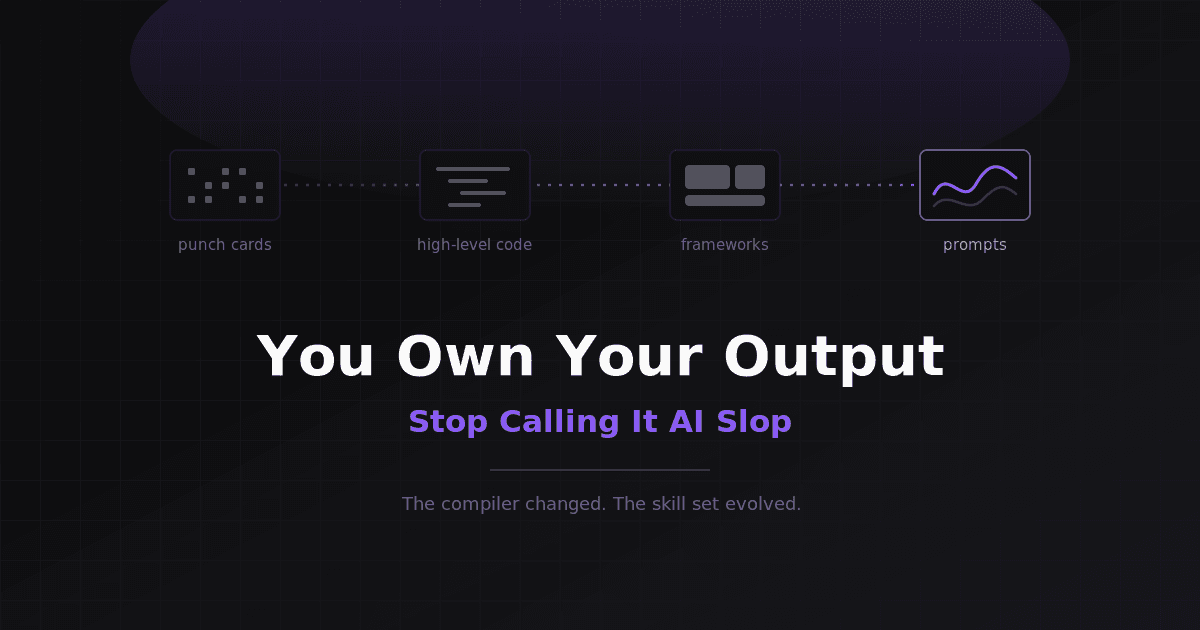
Programming has always evolved through layers of abstraction. Punch cards represented instructions as physical holes in a specific sequence. High-level languages gave us variables, functions, types, and reusable structure. Managed runtimes took over work like memory management. Frameworks let us describe larger behavior without rebuilding every layer. Each step moved us farther from the mechanics of the machine and closer to the outcome we wanted.
Now we are moving again. With agentic coding tools we describe behavior, constraints, architecture, and intent in natural language, and the tool translates that into code.
That does not make natural language magic, and an LLM is not a deterministic compiler. The input is less rigid, the output is probabilistic, and the feedback loop is conversational. But we are still directing a machine to produce an executable result.
We did not stop programming when we stopped punching cards. We will not stop programming when we stop typing every line ourselves.
Abstraction Should Not Remove Skill
Every useful abstraction hides complexity. That is the point. But abstraction never removes the need to understand the system. It changes which knowledge matters, and when.
Agents produce a lot of code quickly. They also produce the wrong code quickly. An implementation can compile, pass a basic test, and still ignore an architectural boundary, introduce a security issue, mishandle an edge case, or solve a different problem from the one users actually have.
Catching that is a decision, not a keystroke. When implementation gets cheap, the decisions become the job: defining the problem, setting constraints, evaluating results, and integrating the solution into a real system.
Typing was never the most important engineering skill. Judgment was.
Using Agents Well Is Its Own Skill
Using agents well is its own skill: scoping the goal, giving the right context, breaking work into changes that can be verified, inspecting the implementation instead of the visible result, writing tests that challenge it, and recognizing when the agent is drifting or confidently wrong. Those are not shortcuts around engineering. They are engineering skills applied through a new interface.
So criticize unreviewable diffs, invented APIs, security vulnerabilities, and code nobody on the team understands. But those are critiques of the work, not proof that the method used to produce it is invalid. Calling everything an agent touched "slop" avoids the questions that actually matter:
- Does it solve the right problem?
- Can the author explain how it works?
- Was it tested beyond the obvious path?
- Would the person who approved it be willing to support it in production?
Those are the standards for any code, no matter how it was written.
This is the biggest change in how we write software that most of us will see in a career, and it is arriving faster than any language or framework shift before it. That speed makes it uncomfortable. It does not make it less real. The answer is not to defend every generated line. It is to raise our standard for ownership.
So read the diff. Run the tests. Challenge the design. Use the speed, but do not surrender the judgment.
The compiler changed. Your responsibility did not.